Enhanced HiCr Iron and HiCr Steel Rolls for Hot Rolling Mills
LONSUN supplies enhanced high-chromium cast iron and high-chromium cast steel rolls for hot-strip, plate, Steckel, skin-pass and selected section-mill duties. Selection must distinguish the iron and steel material directions before hardness or application is compared.
Discuss Your Enhanced HiCr Roll RequirementEnhanced HiCr iron uses a high-chromium shell without free graphite and a tempered martensitic matrix with hard carbides. HiCr steel has lower carbon and a different carbide direction, providing a separate balance of strength and wear resistance. These are related but not interchangeable roll families.
Enhanced HiCr Grades and Stand Applications
The published HCr I–III grades represent high-chromium iron directions, while HCrS represents the lower-carbon high-chromium steel direction.
| GRADE FAMILY | TYPICAL POSITION | COMMON REQUIREMENT | DATA TO REVIEW |
|---|---|---|---|
| HCr I / HCr II / HCr III | Early hot-strip finishing stands | Wear resistance, surface stability and thermal performance | Stand, strip grade, force, temperature, cooling, roughness and current roll |
| Enhanced HiCr iron | Skin-pass and small-section finishing duties | Maintain surface and profile with application-matched hardness | Surface requirement, reduction, pass, speed, cooling and grinding |
| HCrS high-chromium steel | Hot-strip roughing, Steckel and selected early finishing positions | Balance strength, bite, wear and thermal cycling | Reduction, torque, reversing cycle, temperature, cooling and incident history |
Do not select HCrS from the HiCr iron hardness table alone; carbon level, carbide structure, stand duty and mechanical risk are different.
Material Structure and Technical Reference
Chromium, carbon and molybdenum establish different carbide and matrix directions across the HCr range. The published chemistry and property tables should be reviewed together with the actual roll construction and stand position.
Chemical Composition
| Symbol | C | Si | Mn | Cr | Ni | Mo | V |
|---|---|---|---|---|---|---|---|
| HCr I | 2.30-3.30 | 0.30-1.00 | 0.50-1.20 | 12.00-15.00 | 0.70-1.70 | 0.70-1.50 | 0.00-0.60 |
| HCr II | 2.30-3.30 | 0.30-1.00 | 0.50-1.20 | 15.01-18.00 | 0.70-1.70 | 0.70-1.50 | 0.00-0.60 |
| HCr III | 2.30-3.30 | 0.30-1.00 | 0.50-1.20 | 18.01-22.00 | 0.70-1.70 | 1.51-3.00 | 0.00-0.60 |
| HCrS | 1.00-1.80 | 0.40-1.00 | 0.50-1.00 | 8.00-15.00 | 0.50-1.50 | 1.50-4.50 | - |
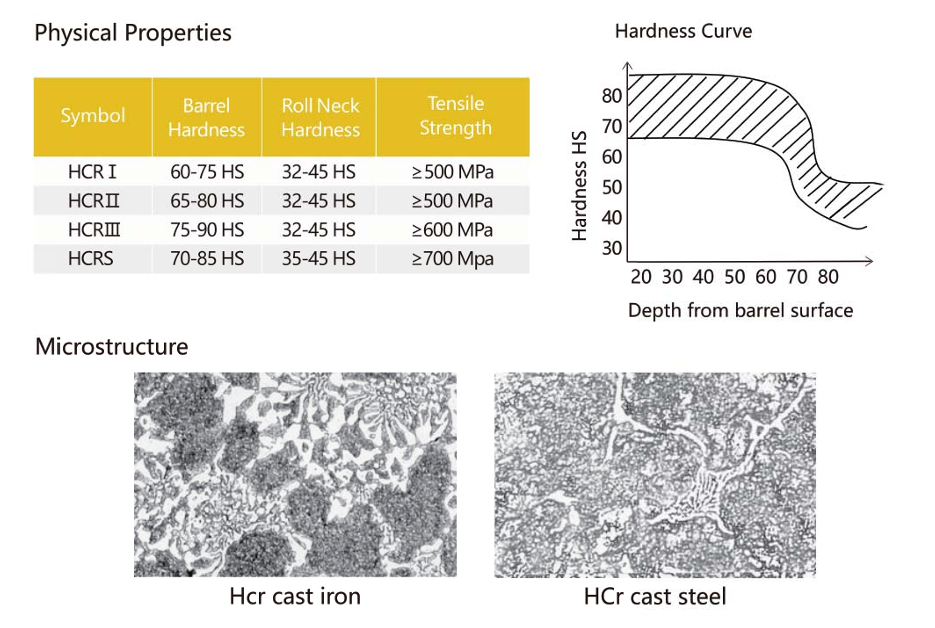
Physical Properties
| Symbol | Barrel Hardness | Roll Neck Hardness | Tensile Strength |
|---|---|---|---|
| HCr I | 60-75 HS | 32-45 HS | ≥500 MPa |
| HCr II | 65-80 HS | 32-45 HS | ≥500 MPa |
| HCr III | 75-90 HS | 32-45 HS | ≥600 MPa |
| HCrS | 70-85 HS | 35-45 HS | ≥700 MPa |
Published values are reference ranges. Confirm whether the order is HiCr iron or HiCr steel, then agree hardness scale/location, working layer, microstructure, NDT and acceptance criteria.
Most service symptoms require joint review of the material family, stand duty, cooling, rolling incidents and grinding history.
| SYMPTOM | POSSIBLE AREAS TO CHECK | INFORMATION NEEDED |
|---|---|---|
| Rapid wear or roughness loss | Iron/steel family match, hardness, scale, slip, product mix and grinding finish | Stand, current material, campaign, wear profile, roughness and stock removed |
| Thermal checking | Temperature gradient, cooling coverage, stoppage, cobble and incomplete crack removal | Crack map, cooling/event log, campaign and grind/NDT history |
| Spalling or peeling | Surface/subsurface crack growth, indentation, local overload, working-layer condition and internal indication | Roll ID, diameter, photographs, event history, spall depth and NDT result |
| Strip or product marks | Oxide/debris, roll roughness, thermal crown, chatter, cooling and grinding | Defect pitch, product side, roll surface, process trend and time of onset |
| Uneven barrel wear | Spray alignment, roll bending, load distribution, crown and stand alignment | Axial wear map, drive/operator-side photographs and rolling settings |
Safety note: visible spalling, deep or growing cracks, abnormal vibration/noise, neck distress, coolant loss or a major cobble should be handled under the mill’s own safety procedure.
RFQ and Procurement Checklist
A complete RFQ reduces repeated clarification and prevents the quotation from being based only on size and hardness. The buyer’s data and the supplier’s confirmation should form one technical-commercial baseline.
| RFQ ITEM | BUYER PROVIDES | LONSUN CONFIRMS |
|---|---|---|
| Drawing and dimensions | Drawing revision, barrel and neck dimensions, fillets, grooves or pass details, and mounting features | Manufacturing scope, tolerances, machining, working layer where applicable, and drawing exceptions |
| Mill and application | Mill type, stand, roll function, rolled product, steel grade and pass | Proposed Enhanced HiCr grade, hardness and application basis |
| Operating conditions | Rolling force, torque, reduction, speed, stock temperature, cooling and lubrication where used | Material direction, key operating risks and inspection conditions |
| Current performance | Current roll material, hardness, campaign, wear, grinding and incident history | Comparison basis, evaluation method and technical risks to monitor |
| Quality documents | Required chemistry, hardness, microstructure, NDT, dimensions and third-party inspection | Test method, coverage, acceptance criteria and document list |
| Commercial requirement | Quantity, destination, required delivery date, packaging and Incoterm | Price basis, production scope, delivery basis, packing and quotation validity |