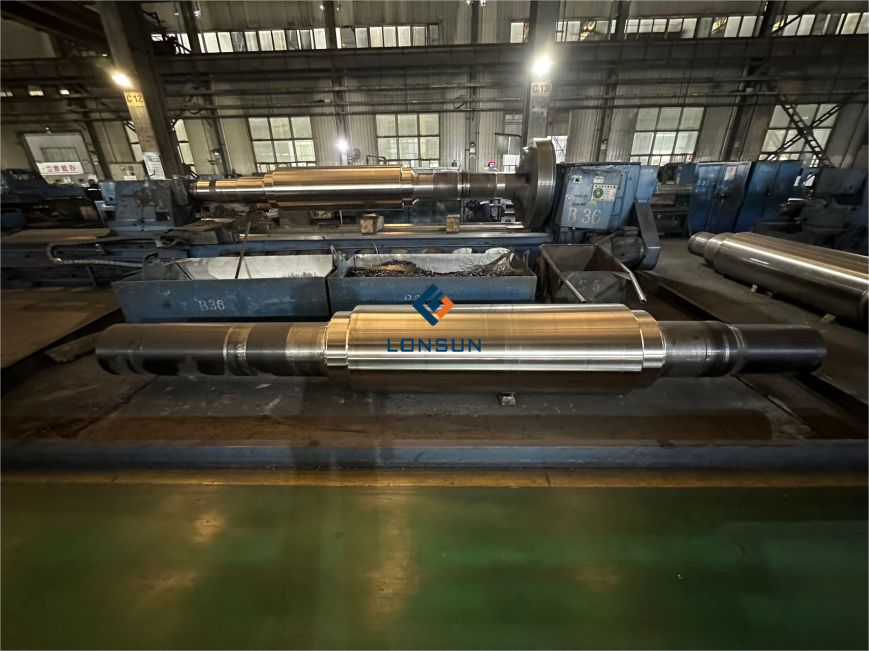
Forged Steel Rolls for Cold Rolling Mills
LONSUN supplies forged steel work rolls, intermediate rolls and backup rolls for cold rolling applications. Selection connects grade, working-layer hardness, hardening depth, toughness, surface finish, dimensional accuracy and resistance to accidental damage.
Discuss Your Forged Cold Roll RequirementForged cold-mill rolls are produced through controlled forging, heat treatment and precision machining to obtain high, homogeneous working-layer hardness and the required support properties. Published hardened-layer depth can exceed 30 mm depending on design and application, but the usable layer and acceptance method must be defined for each order.
Forged Cold Roll Applications and Hardness Direction
Work-roll, intermediate-roll and backup-roll duties place different demands on hardness, toughness, surface finish, neck condition and dimensional control.
| PORTION / APPLICATION | PUBLISHED HARDNESS REFERENCE | COMMON REQUIREMENT | DATA TO REVIEW |
|---|---|---|---|
| Barrel: finishing work rolls for strip and plate mills | 90–96 HS | High and homogeneous working-layer hardness with controlled surface finish | Mill type, strip grade, width, reduction, roughness and current roll |
| Barrel: cold work and temper rolls for non-ferrous strip, foil and bright sheet | ≥95 HS | Surface quality, wear stability and application-matched toughness | Rolled alloy, finish, flatness, load, lubrication and polishing/grinding |
| Neck: small-diameter cold work roll with needle bearing | ≥80 HS | Bearing-zone wear resistance and dimensional compatibility | Bearing type, neck drawing, fit, load, lubrication and runout |
| Neck: special wear requirement | 50–70 HS | Controlled neck hardness for bearing or seal service | Contact condition, fit, surface finish, load and maintenance history |
| Neck: work roll without special requirement | 30–50 HS | Balance support strength, machinability and bearing duty | Roll design, bearing/chock arrangement, load and acceptance method |
Hardness values above reproduce the current published reference. Confirm scale, instrument, test position and whether the stated value applies to surface, barrel or neck.
Material and Technical Reference
The FSC grade range varies carbon, chromium, molybdenum, vanadium and tungsten to support different hardening and service directions. Chemistry must be interpreted with forging, heat treatment and roll geometry.
Chemical Composition
| Symbol | C | Si | Mn | Cr | Ni | Mo | V | W |
|---|---|---|---|---|---|---|---|---|
| FSC-1 | 0.80-0.95 | 0.15-0.45 | 0.20-0.55 | 1.70-2.40 | ≤0.25 | 0.20-0.40 | ≤0.15 | - |
| FSC-2 | 0.80-0.95 | 0.25-1.00 | 0.20-0.70 | 2.40-3.50 | ≤0.25 | 0.20-1.00 | 0.05-0.15 | - |
| FSC-3 | 0.75-0.95 | 0.20-1.00 | 0.20-0.50 | 2.80-3.60 | ≤0.80 | 0.15-0.40 | - | - |
| FSC-4 | 0.60-0.80 | 0.30-0.80 | 0.40-0.90 | 2.50-3.50 | ≤0.80 | 0.20-0.60 | - | - |
| FSC-5 | 0.70-0.95 | 0.20-0.90 | 0.20-0.50 | 4.00-6.00 | ≤0.80 | 0.15-1.20 | 0.35 | - |
| FSC-6 | 0.33-0.43 | 0.80-1.20 | 0.20-0.50 | 4.75-5.50 | ≤0.80 | 1.10-1.60 | 0.30-0.60 | - |
| FSC-7 | 0.80-0.90 | ≤0.40 | ≤0.40 | 3.80-4.40 | ≤0.80 | 4.50-5.50 | 1.75-2.20 | 5.50-6.75 |
Published Barrel and Surface Hardness (HS)
| Hardness | FSC-1 | FSC-2 | FSC-3 | FSC-4 | FSC-5 | FSC-6 | FSC-7 |
|---|---|---|---|---|---|---|---|
| Barrel | 60-80 | 76-80 | 60-80 | 60-70 | 65-75 | 65-71 | 80-95 |
| Surface | 90-100 | 90-100 | 90-100 | 65-80 | 90-100 | 75-82 | - |
Recommended Hardness Reference (HS)
| Portion | Application | Hardness |
|---|---|---|
| Barrel | Finishing work rolls for strip and plate mills | 90-96 |
| — | Cold work rolls and temper rolls for non-ferrous strip, foil and bright sheet | ≥95 |
| Neck | Small diameter cold work rolls installed with needle roller bearing | ≥80 |
| — | Cold work rolls with particular requirement of resistance to wear on bearing portion | 50-70 |
| — | Work rolls without special requirement | 30-50 |
Confirm working-layer and hardening-depth definition, hardness profile, residual-stress requirement, ultrasonic inspection, surface finish, dimensional tolerance, runout and final acceptance documents.
Cold-roll symptoms can originate from material, residual stress, grinding, surface preparation, bearings, mill setup or accidental overload. Preserve the roll and process evidence.
| SYMPTOM | POSSIBLE AREAS TO CHECK | INFORMATION NEEDED |
|---|---|---|
| Abnormal wear or roughness change | Grade/hardness profile, strip material, reduction, lubrication, grinding and surface finish | Campaign, diameter, roughness, wear profile, strip mix and stock removed |
| Crack, peeling or spalling | Surface/subsurface crack growth, indentation, overload, residual stress, grinding burn and NDT history | Roll ID, current diameter, defect map, photographs, incident and grinding records |
| Strip marks or chatter | Roll surface, roughness, vibration, bearing/chock condition, coolant, speed and grinding pattern | Defect pitch, strip side, vibration/process trend, roll surface and bearing inspection |
| Neck or bearing-zone wear | Hardness direction, fit, lubrication, bearing condition, misalignment and surface finish | Neck drawing, measurements, bearing/chock data, runout and maintenance record |
| Runout, shape or flatness instability | Roll geometry, crown/profile, straightness, thermal behavior, alignment and bending setup | Dimensional report, profile/runout, strip shape trend and mill settings |
Safety note: a detected crack, visible spalling, neck distress, abnormal vibration/noise or a major overload should be handled under the mill’s own safety and roll-inspection procedure before reuse.
RFQ and Procurement Checklist
A complete RFQ reduces repeated clarification and prevents the quotation from being based only on size and hardness. The buyer’s data and the supplier’s confirmation should form one technical-commercial baseline.
| RFQ ITEM | BUYER PROVIDES | LONSUN CONFIRMS |
|---|---|---|
| Drawing and dimensions | Drawing revision, barrel and neck dimensions, fillets, grooves or pass details, and mounting features | Manufacturing scope, tolerances, machining, working layer where applicable, and drawing exceptions |
| Mill and application | Mill type, stand, roll function, rolled product, steel grade and pass | Proposed forged cold-mill grade, hardness and application basis |
| Operating conditions | Rolling force, torque, reduction, speed, stock temperature, cooling and lubrication where used | Material direction, key operating risks and inspection conditions |
| Current performance | Current roll material, hardness, campaign, wear, grinding and incident history | Comparison basis, evaluation method and technical risks to monitor |
| Quality documents | Required chemistry, hardness, microstructure, NDT, dimensions and third-party inspection | Test method, coverage, acceptance criteria and document list |
| Commercial requirement | Quantity, destination, required delivery date, packaging and Incoterm | Price basis, production scope, delivery basis, packing and quotation validity |