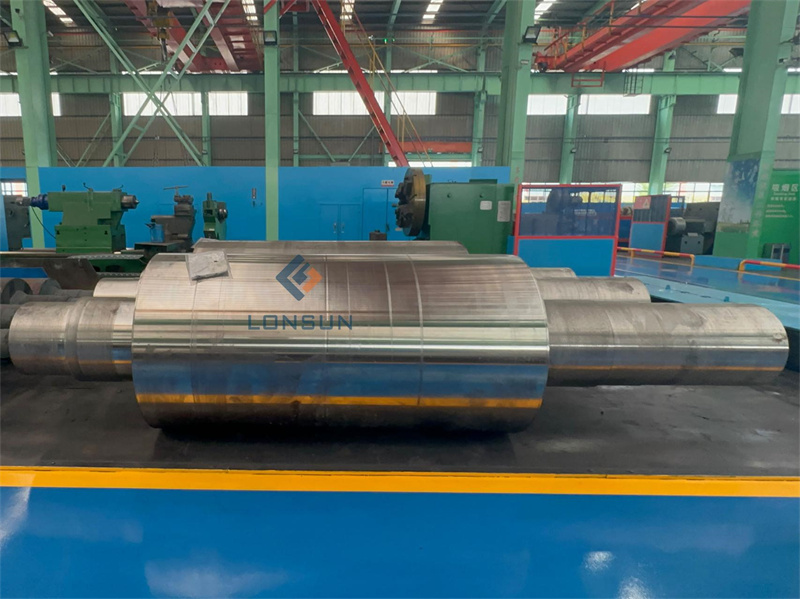
Adamite Rolls and Rings for Roughing and Intermediate Stands
LONSUN supplies Adamite rolls and rings selected around the mill type, stand position, pass design, rolling load, current roll performance and operating conditions. The objective is a practical balance of wear resistance, toughness, fire-crack resistance and reliable mechanical strength.
Discuss Your Adamite Roll RequirementAdamite is a cast steel roll material with controlled carbon and alloy additions such as nickel, chromium and molybdenum. Products can be made by static monoblock casting or horizontal centrifugal casting according to the roll design and application. Grade, hardness, casting route and dimensions must be matched to the actual stand—not selected from carbon content alone.
Adamite Roll Applications and Selection Basis
Adamite is used across several roughing, intermediate and selected finishing duties. The stand position and the dominant failure risk determine the grade and manufacturing direction.
| APPLICATION AREA | TYPICAL ROLL POSITION | COMMON REQUIREMENT | DATA TO REVIEW |
|---|---|---|---|
| Section, bar and wire rod mills | Roughing stands | Combine biting capability and toughness with practical wear resistance | Pass drawing, reduction, torque, rolling temperature, cooling and current wear |
| Hot strip mills | Roughing, early finishing and vertical stands | Control thermal cracking and wear under heavy hot-rolling duty | Rolling force, temperature, scale, cooling, campaign and incident history |
| Section and beam mills | Roughing, intermediate and pre-finishing stands | Maintain pass geometry while carrying mechanical load | Groove depth, load concentration, guides, wear map and redressing practice |
| Universal mills | Rings and sleeves for vertical and horizontal stands | Match strength, fit and surface performance to the assembly | Ring or sleeve drawing, interference, shaft data, pass and mounting method |
Final suitability is confirmed against the stand duty, roll drawing, current material and the mill’s own campaign and grinding basis.
Material and Technical Reference
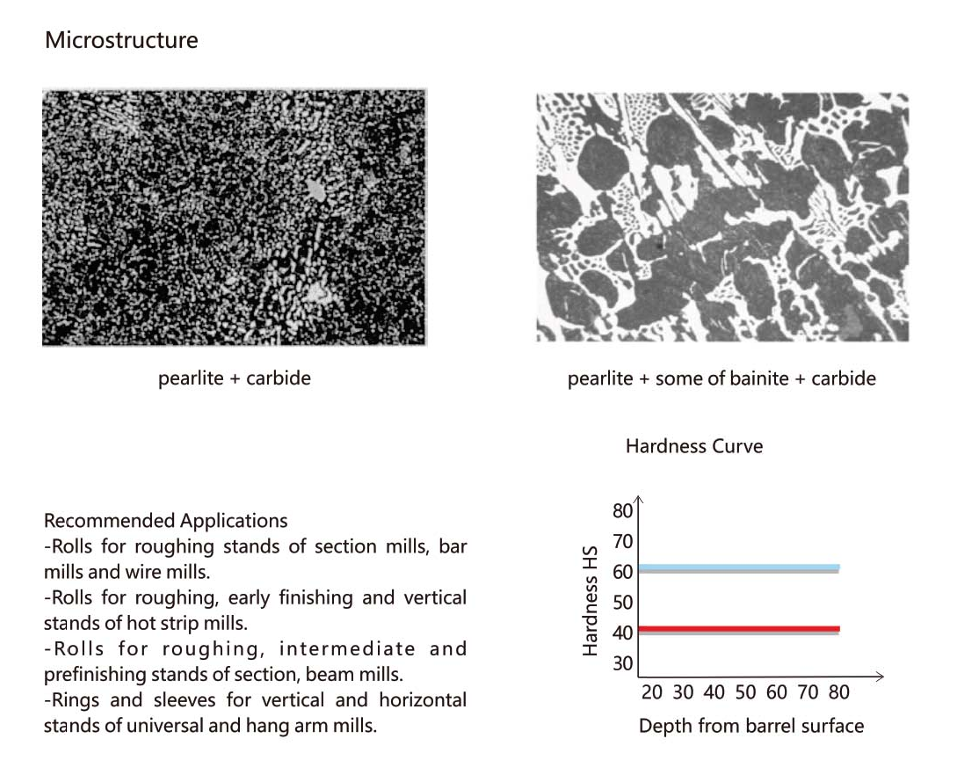
The published Adamite grades cover different carbon, alloy and hardness ranges. Higher hardness is not automatically the best choice where bite, toughness, thermal cycling or incident margin has priority.
Chemical Composition and Physical Properties
| Symbol | C | Si | Mn | Cr | Ni | Mo | Barrel Hardness (HS) | Roll Neck Hardness (HS) | Tensile Strength (MPa) |
|---|---|---|---|---|---|---|---|---|---|
| AD140I | 1.30-1.50 | 0.30-0.60 | 0.70-1.10 | 0.80-1.20 | 0.50-1.20 | 0.20-0.60 | 35-50 | ≤48 | ≥500 |
| AD160I | 1.50-1.70 | 0.30-0.60 | 0.80-1.30 | 0.80-2.00 | ≥0.20 | 0.20-0.60 | 40-60 | ≤50 | ≥450 |
| AD180 | 1.70-1.90 | 0.30-0.80 | 0.60-1.10 | 0.80-1.50 | 0.50-2.00 | 0.20-0.60 | 45-60 | ≤50 | ≥350 |
| AD190 | 1.80-2.00 | 0.30-0.80 | 0.60-1.20 | 1.50-3.50 | 1.00-2.00 | 0.20-0.60 | 55-65 | ≤50 | ≥350 |
| AD200 | 1.90-2.10 | 0.30-0.80 | 0.80-1.20 | 0.60-2.00 | 0.60-2.50 | 0.20-0.80 | 50-65 | ≤50 | ≥350 |
Published values are reference ranges. Confirm grade, casting route, hardness scale, test location, working layer where applicable and acceptance criteria in the order specification.
A visible symptom does not identify one cause. Material and manufacturing records should be reviewed together with pass duty, cooling, mill incidents and grinding history.
| SYMPTOM | POSSIBLE AREAS TO CHECK | INFORMATION NEEDED |
|---|---|---|
| Rapid or uneven wear | Grade and hardness match, scale, slip, load concentration, pass profile, guides and cooling distribution | Stand, pass, product mix, wear map, tonnage, diameter and grinding loss |
| Fire cracks or thermal checking | Thermal cycling, uneven or interrupted cooling, stoppage, cobble, local overload and incomplete crack removal | Crack map, cooling and event logs, campaign, diameter and grind/NDT history |
| Spalling or peeling | Crack propagation, indentation, rolled-in scale, local overload, casting condition or internal indication | Roll ID, incident history, complete and close photographs, spall depth and NDT results |
| Neck distress or breakage | Load and torque peaks, fillet geometry, bearing/chock condition, alignment, material strength and handling | Drawing, fracture location, load/event data, bearing condition and inspection records |
| Poor bite or unstable rolling | Surface condition, pass design, reduction, temperature, scale, speed and guide alignment | Time of onset, process trend, roll surface, pass and current operating window |
Safety note: deep or growing cracks, visible spalling, neck distress, abnormal vibration or noise, sudden coolant loss or a major cobble should be handled under the mill’s own safety procedure.
RFQ and Procurement Checklist
A complete RFQ reduces repeated clarification and prevents the quotation from being based only on size and hardness. The buyer’s data and the supplier’s confirmation should form one technical-commercial baseline.
| RFQ ITEM | BUYER PROVIDES | LONSUN CONFIRMS |
|---|---|---|
| Drawing and dimensions | Drawing revision, barrel and neck dimensions, fillets, grooves or pass details, and mounting features | Manufacturing scope, tolerances, machining, working layer where applicable, and drawing exceptions |
| Mill and application | Mill type, stand, roll function, rolled product, steel grade and pass | Proposed Adamite grade, hardness and application basis |
| Operating conditions | Rolling force, torque, reduction, speed, stock temperature, cooling and lubrication where used | Material direction, key operating risks and inspection conditions |
| Current performance | Current roll material, hardness, campaign, wear, grinding and incident history | Comparison basis, evaluation method and technical risks to monitor |
| Quality documents | Required chemistry, hardness, microstructure, NDT, dimensions and third-party inspection | Test method, coverage, acceptance criteria and document list |
| Commercial requirement | Quantity, destination, required delivery date, packaging and Incoterm | Price basis, production scope, delivery basis, packing and quotation validity |